
Australian life sciences company Medical Ethics announce a £3 million investment in Wales

Melbourne-based life science research and development company Medical Ethics has announced a direct investment of over £3 million in Wales over the next three years, making Cardiff its new base in the northern hemisphere.

Medical Ethics develop products that alleviate pain and minimise suffering associated with wounds and surgical procedures in animals. As a UK hub for life sciences expertise, Wales will provide the company with the ideal base to progress the development of its technology for humans.

Medical Ethics chose to invest in the UK for its expertise in a number of fields required for the commercialisation of the company’s technology. This includes regulatory affairs, manufacturing and clinical studies, tax subsidies and patent box incentives.

Currently Medical Ethics engages 18 independent service providers and consultants across the UK and has plans to expand its headcount. The company will also look to use other UK consultants and service providers as it addresses future regulatory and commercialisation requirements.

Medical Ethics has worked with the Department for International Trade (DIT) for two years, receiving advice, grant application assistance and introductions to key UK stakeholders including the Wales Wound Institute in Cardiff and Cardiff University, both of which the company now collaborates with. Without DIT’s support, the company would not have been able to identify these connections and would not have chosen the UK as a location for investment.

Allan Giffard, Managing Director, Medical Ethics said:
“For us, Wales was the obvious choice in the UK, especially given our sector – Life Sciences. Wales offers the skills, expertise and infrastructure for our business to thrive.

“Through DIT, we’ve been able to participate in the Global Entrepreneur Programme, enabling us to overcome a number of initial challenges. DIT, along with Innovate UK, also supported us with introductions to key experts including the Wales Wound Institute in Cardiff – an introduction which had a significant impact on our decision to choose the UK.

“When looking to expand internationally, we initially looked at a number of countries. However, we believe it would have been a more difficult process in these territories as we did not identify programmes that provide the same level of support we’ve been offered in the UK.”

Secretary of State for Wales Alun Cairns said:

“This announcement is testament to the strong appetite worldwide for investing in the UK, and is a real vote of confidence in Wales’ growing stature as a hotbed of life sciences expertise.

“It also showcases the commitment of the UK Government’s globally based network of trade experts to connect international investors with the right partners for their needs.

“Companies like Medical Ethics are helping to change health dynamics on a global scale and are quickly discovering that Wales is the go-to place to develop, manufacture and commercialise theirinnovations. The UK Government knows this and we have every intention of nurturing this industry for continued success in Wales and across the UK for years to come.”

Graham Stuart, Minister for Investment, Department for International Trade said:
“With a world-class network of universities, clinicians and industry professionals, Wales has a proven capacity in providing the expertise required by both domestic and international life science companies.

“It is now at the forefront of numerous pioneering developments across a wide variety of fields, from microbiology to pharmaceuticals. Medical Ethics’ investment in Wales is an affirmative nod to this and, as an international economic department, DIT is thrilled to have provided support.”

In the year 2016-17, DIT reported 85 investment projects in Wales, generating 2,581 jobs. Welsh companies exported more than £16.4bn of goods in 2017. The UK is the number one destination for health and life sciences Foreign Direct Investment in Europe.

Further information
• Contact the DIT Media and Digital Team on 020 7008 3333
• Follow us: @tradegovuk | gov.uk/dit
• Contact the Medical Ethics UK media team on 020 3727 1000.
Tri-Solfen registered in New Zealand for sheep and cattle husbandry procedures

Third registration received for the Group’s innovative pain mitigation product

Expanding Tri-Solfen’s commercial potential

Melbourne, Australia – 16 November 2017 – Medical Ethics Pty Ltd (“Medical Ethics” or “the Group”), a commercial and development company  focused on pain mitigation in wounds for humans  and animals, announces that its wholly owned subsidiary, Animal Ethics Pty Ltd (Animal Ethics), has successfully registered Tri-Solfen in New Zealand for sheep  and cattle husbandry procedures. Tri-Solfen is a local anaesthetic and antiseptic gel spray that adheres well to wounds and acts as a barrier to environmental stimuli, promotes haemostasis and improve wound healing. Tri-Solfen was registered through the Ministry for Primary Industries, which leads and facilitates the management of animal welfare policy and practice in New Zealand.

Over one billion livestock animals globally undergo highly invasive painful husbandry procedures annually. Tri-Solfen is already registered in Australia separately for sheep  and cattle husbandry procedures, where it is marketed and distributed by Bayer Animal Health, a global leader in animal health. To date, Tri-Solfen has been used to successfully treat over 80 million animals undergoing routine surgeries in the Australian livestock industries.

Animal Ethics accelerated the expansion of its global registration programmes earlier this year through a commercial partnership with Dechra Pharmaceuticals PLC (Dechra), a FTSE 250 international veterinary pharmaceutical business. As part of the partnership, Dechra became a cornerstone investor in Medical Ethics and, in a separate agreement with Animal Ethics, secured  the global licensing rights (excluding Australia and New Zealand) for the Group’s proprietary platform technology in animals. Dechra will support the Group’s strategy  to register Tri-Solfen in major international markets, such as the EU and US.

Allan Giffard, Managing Director of Medical Ethics, commented:

“Over one billion livestock animals globally undergo highly invasive painful husbandry procedures annually.  This registration is an important milestone for Medical Ethics as we further expand  our international reach and help to minimise suffering associated with wounds in livestock. Farming communities globally are responding to new animal welfare pressures,  and Tri-Solfen is proven to deliver a highly effective, practical and cost-efficient solution to improve animal welfare outcomes. We are currently in multiple marketing and distribution rights negotiations to bring this globally recognised technology to New Zealand.”

– Ends –

Contacts:


Medical Ethics Pty Ltd, Tel:  +61 419 362 286

Allan Giffard, Managing Director

Charles Olsson, Marketing Director


FTI Consulting, Tel: +44 20 3727 1000

Brett Pollard / Victoria Foster Mitchell / Abbas Omaar


Notes for editors:

About Medical Ethics Pty Ltd

Medical  Ethics  Pty Ltd  is a  commercial  and  development  company  focused  on  pain  mitigation  in  wounds  for humans  and  animals.  Our  vision  is to develop  and  deliver  our  proprietary  highly  effective,  safe, affordable  and practical pain relief platform to prevent  pain and  minimise suffering associated with wounds  in humans,  livestock and companion animals. Medical Ethics is focused  on the development of the Group’s patented technology initially for the treatment of chronic wounds such as diabetic leg ulcers. Animal Ethics, a wholly owned  subsidiary of Medical Ethics, is the first, and currently the only, company globally to develop, launch and commercialise a topical pain and wound management product for use in livestock undergoing painful husbandry procedures.

In March 2017, Medical Ethics secured  investment from Dechra Pharmaceuticals PLC (Dechra) in exchange for a 33% shareholding in the Group. A separate global license agreement (excluding Australia and  NZ) was entered into by Dechra  and  Animal  Ethics  to  secure  the  marketing  and  distribution  rights  of the Group’s  proprietary  platform technology in animals.

About Tri-Solfen

Tri-Solfen is a local anaesthetic and antiseptic gel spray that adheres well to wounds and acts as a barrier to environmental stimuli, promotes haemostasis and improves wound healing. Tri-Solfen contains two proven topical local anaesthetics; fast-acting Lignocaine for immediate pain relief and long-acting Bupivacaine for prolonged post- operative pain relief. Adrenaline is included for its ability to reduce  the shock and stress of blood loss, whilst prolonging the anaesthetic action. Tri-Solfen also contains Cetrimide; an antiseptic widely used to cleanse skin and wounds and provides protection from bacterial contamination.

The global market potential for Tri-Solfen is estimated to be in excess of AUD $350 million per year for the treatment of routine on farm procedures in calves, lambs and piglets.

Zanda’s cattle pain relief vision on show

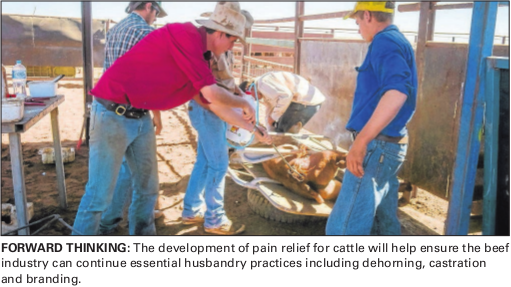
IT’S a matter of seeing is believing. A squirt of the blue gel from the purpose made applicator onto the wounds left by the dehorning, branding or, in the case of bull calves, castration, and the job is done.

But it’s the behaviour of those young calves almost immediately after leaping up from the branding cradle that is perhaps the most impressive. Despite having just undergone these invasive animal husbandry practices, only minutes later they stand with their mates appearing calm and relaxed.

There is no headshaking, no calves lying down, and no obvious distress. Most impressive is there is no visible bleeding. In fact, because of the barrier the blue gel creates across the entire wound, it is hard to even see the wound.

For major pastoral company MDH, the use of the Bayer pain relief product Trisolfen on its Cloncurry property, Devoncourt, is as an integral part of its husbandry practices at branding. Partly because it reduces the stress imposed on the young animals, partly because it helps guard against infection, and partly because it is part of bigger picture of ensuring that on-farm animal husbandry practices are inline with consumers expectations.

Mount Isa-based vet Ed Butterworth, North West Veterinary Clinic, who helps oversee the 170,000 head MDH herd is clearly impressed with the effectiveness of the now commercially available pain relief product.

“It’s easy to use and obviously effective,” Dr Butterworth said.

“The behaviour of the calves suggests they are obviously under less stress once the pain relief has been applied.”

Initially developed to provide pain relief for lambs after mulesing, Trisolfen is a pain relieving and wound healing formulation that has short term and long term analgesia, antiseptics, reduces blood loss and coats the wound. It costs between about a $1 and $1.50 to treat each animal. It is described as best suited to calves aged six to eight weeks and is designed to provide pain relief for 24 to 36 hours. Bayer, which manufactures Trisulfen under license from Animal Ethics, has formulated a thicker gel that has an 18 month shelf life.

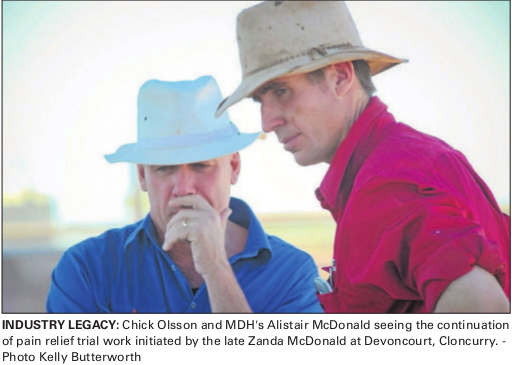
Alistair McDonald said MDH was likely use Trisolfen on all of the more than 40,000 calves from next year, pending final registrations. “The benefits to the calves from Trisolfen are obvious and significant,” Mr McDonald said. “Since we started the trial work in 2012 we’ve been working out the best way to use the product. It really takes away the stress and the calves are looking for a drink within minutes.”

MDH uses Angus bulls as terminal sires over high grade Brahman females on Devoncourt. The majority of the cattle bred by MDH are fed through the company’s Wallumba Feedlot at Condamine.

Mark Phelps flew with Pilatus Australia, in recognition of the late Zanda McDonald, who helped initiate theTrisolfen trial work.

Why pain relief really matters

IT WAS borne from the recognition that the livestock industry needed to stay ahead of the game. A kitchen table conversation between forward thinking Cloncurry-based pastoralist, the late Zanda McDonald, and industry leader Chick Olsson more than 10 years ago questioned how the beef industry could ensure the continued use of essential husbandry practices including dehorning, castration and branding.

Disturbed by the ongoing and damaging campaign launched by US-based extreme animal rights group PETA on the wool industry and its use of mulesing, the pair recognised that the beef industry was potentially open to attack.

Regardless of how important the practices were ultimately to an animal’s long term welfare, conventional husbandry practices – particularly those that involved invasive surgery – could easily be misconstrued by activist groups campaigning to destroy consumer confidence in the $17 billion industry.

Part of the solution lay in providing pain relief that was both effective and able to be applied in difficult environment presented by busy and dusty cattle yards. Enter Trisolfen, a product developed by Animal Ethics, a company owned by Mr Olsson and other keen investors determined to counter PETA’s attack on Australian wool. The antiseptic gel now licensed to Bayer Trisolfen is a pain relieving and wound healing formulation that has short term and long term analgesia, antiseptics, reduces blood loss and coats the wound.

“When PETA started campaigning against mulesing, US retailers of Australian wool began dropping like flies,” Mr Olsson said. “The industry could fight PETA all it wanted and argue that mulesing was essential, but the reality was retailers were refusing to sell Australian wool and increasing numbers of consumers were refusing to buy Australian wool.

“Until the use of pain relief became widespread, PETA was winning and the only losers were Australian woolgrowers. Zanda could see a potentially similar problem emerging for the beef industry. We needed to be proactive and ensure the way we produce beef is in line with consumer expectations about how animals are treated.”

World 1st: Tri-Solfen® approved for use in calves

In a ground breaking new development for farmers and for animal welfare – the Australian Veterinarian Medicine regulator (APVMA) has now extended the approved use of Tri-Solfen® anaesthetic and antiseptic topical application to include the alleviation of pain in calves.

Tri-Solfen® is already approved by the APVMA, and widely used in over 8 million lambs per year to alleviate pain from husbandry procedures such as castration, tail docking and mulesing.

Tri-Solfen® has a unique 3-way action designed to numb the wound, minimise bleeding and protect against infection. Scientific trials have demonstrated pain alleviation up to 24 hours in calves after surgical castration and a significant improvement in wound healing in lambs. To date, Over 70 million animals have been treated with Tri-Solfen®, with the product purchased over the counter in Australia from local veterinarians or from rural retailers.

On-going trials conducted by Sydney University Veterinary School and were used to support the registration, confirmed that Tri-Solfen® is highly effective and safe to alleviate pain post castration and disbudding in calves. In addition recent studies conducted by Sydney University have also confirmed a significant reduction in pain associated with piglet castration and these studies will be used to extend the use in piglets in the near future.

It is a major win for farmers, a win for calves, a win for animal welfare – and a win for the Australian cattle and dairy industry says Allan Giffard, Managing Director of Animal Ethics. Tri-Solfen® is now approved to provide a practical means for farmers to alleviate the pain associated with husbandry procedures in calves, which are relied on for important animal health and management reasons. This in turn may improve mothering-up, minimise set-back, while also addressing consumer concerns over welfare.

‘Farm animals experience pain in the same way as dogs, cats and other companion animals. They deserve the same respect and effort to develop safe, affordable and effective pain relief and wound care that is practical for farmers to use. Tri-Solfen® provides the first important product to address this need’.

Allan Giffard concluded “This is a very exciting milestone for our company and the new calf registration sets a solid platform for Animal Ethics as we continue our international registration program in key markets such as the USA, EU, Canada, New Zealand and South America.

­– Ends­ –

About Medical Ethics

Medical Ethics is a commercial and development stage company focused on pain mitigation in wounds for humans and animals.

Through our proven patent protected platform technology, we have identified a transformational way of mitigating pain and minimising suffering associated with wounds.

About Tri-Solfen®

Tri-Solfen® is a local anaesthetic and antiseptic gel spray that adheres well to wounds and acts as a barrier to environmental stimuli, promotes haemostasis and improves wound healing. Tri-Solfen® contains two proven topical local anaesthetics; fast-acting Lignocaine for immediate pain relief and long-acting Bupivacaine for prolonged post-operative pain relief. Adrenaline is included for its ability to reduce the shock and stress of blood loss, whilst prolonging the anaesthetic action. Tri-Solfen® also contains Cetrimide; an antiseptic widely used to cleanse skin and wounds and provides protection from bacterial contamination.